
- Aug 11
Selective Innocence and the Price of Telling the Truth
- Sobia Ali-Faisal
- liberation, hope, change agents, future, solidarity, decolonize, honesty
- 0 comments
I recently came across an Instagram post by Fatima Khadijah (@iamfatimakhadijah) which really stayed with me. It said:
"Whiteness is a system of rewards for staying silent about the suffering of others, particularly Black and Brown people."
"The moment compassion becomes inconvenient to white hegemony, it is rebranded as extremism."
"The moment we become a friend to humanity, we become an enemy to whiteness."
I read that post and thought: I know exactly what this means. Because I lived it.
The post introduced a concept called selective innocence - a deliberate choice to ignore uncomfortable facts, systemic realities, or personal complicity while maintaining a posture of moral purity.
It's what allows a system built on genocide to call itself "discovery." It's what allows institutions to silence critics while claiming to value diversity. It's what allows people to stay comfortable while others suffer.
And it's what I ran headfirst into when I told the truth about what I was seeing.
I. My Story
I was the Director of Equity, Diversity, and Inclusion and Human Rights at the University of Prince Edward Island.
And I was fired for posting - on my own time, on my own personal accounts - about anti-Zionism and anti-casteism.
The Faculty Association filed an informal complaint. Said I was "biased."
Not wrong. Biased.
As if calling out oppression is bias. As if being honest about brutality is the problem, not the brutality itself.
I'm South Asian. Casteism impacts my community. I'm Muslim. Zionism has been at the forefront of perpetuating anti-Muslim racism. I posted about both. Because both impact me personally. Because both are systems of oppression that demand to be named.
About a month after the complaint, the university fired me. No warning. No due process. A less-than-one-minute conversation with my boss, and I was gone. No one argued with the substance of what I said. They couldn't. So they made it about who I am: a Muslim woman, a South Asian woman, a person who refuses to be "neutral" about a genocide.
That's how power protects itself when it can't win on logic. It doesn't engage with your arguments. It removes you.
And then, later that day, they sent an email statement to the campus community about "workplace culture concerns" and suggested the campus was safer without me.
Here's what I've learned: hate and fear don't want truth. What they need is a story to keep the hate and fear going. And the story of the dangerous Muslim has been circulating for centuries. It made people panic about Zohran Mamdani leading New York. And it made UPEI remove me, without dignity, without reason, without a single conversation about why or an opportunity to defend my truth.
II. The Civilization-Level Lies
A few years ago, forensic psychiatrist Dr. Aruna Khilanani was asked in an interview: "Based on your expertise, are white people psychopathic?"
She said yes, not because every white person has a clinical disorder (she was explicit that this was metaphorical), but because of the scale of lying that has been normalized since colonialism.
She gave this example: when you steal a country, loot it, commit genocide against the people there, and then say you "discovered" it.
That is not a small lie. That is a civilization-level lie.
We put it in history books. We teach it to children. We call it "exploration" and "settlement."
The interviewer pressed her: is this about a culture of theft, or is it about individual white people?
She answered:
"I think there is a useful distinction to be made. On one level, yes, that's absolutely true. And it's different than actual individual psychopathy the way people conceive of it. On another level, when we are thinking about individual responsibility and how it is that people change, I think that using the words 'systemic' and 'culture' can operate defensively to not actually let yourself go into your own unconscious and go into those dark places of what you're actually doing."
Her point was this: as long as white people are unwilling to recognize those lies - as long as they walk around with what she called a "psychopathic understanding of the world" where theft becomes discovery and genocide becomes settlement - you cannot address racism.
You cannot solve a problem you refuse to name honestly.
She also said that the system operates defensively. That white people have a "different conscious experience of themselves" than what they are actually doing. That naming the gap between identity and action—naming the lie—is what makes the system furious.
She was speaking to an audience of psychiatrists and mental health workers. She was inviting them into a sacred space to see how white people are actually viewed by those harmed by white supremacy. She was asking them to sit with the discomfort.
And the system responded by reducing her to a soundbite: "White people are psychopaths."
I named the gap. I said: genocide is happening, and I won't be neutral about it. I said: casteism is real, and I won't be silent about it.
And the system removed me.
III. The Question That Haunts Me
Here's what I keep coming back to.
If you accept civilization-level lies - if you benefit from a system built on theft, genocide, and erasure, and you never say those lies out loud - are you actually an honest person?
If you engage in selective innocence - if you deliberately choose to ignore uncomfortable facts and systemic realities while maintaining a posture of moral purity - are you actually a good person?
Or are you just a well-adjusted participant in a very old delusion? And a delusion that actively harms and oppresses people. Are you just a well-adjusted participant in harm and oppression?
Dr. Khilanani put it this way: as long as you refuse to go into those dark places of what you're actually doing, as long as you refuse to acknowledge the disconnect between your identity and your actions, you cannot change. Because you cannot solve a problem you refuse to name honestly.
Fatima Khadijah put it this way: whiteness is a system of rewards for staying silent. The moment you stop staying silent, you risk losing your proximity to whiteness. You risk being rebranded as extremist, biased, or dangerous.
So the question isn't just about honesty. It's about what you're willing to lose.
IV. The Politics of Whiteness and Selective Innocence
Around the same time, another truth-teller was facing backlash.
Ms. Rachel, the children's entertainer beloved by millions, spoke out for the safety of Black and Brown children. She used her platform to advocate for inclusion, for protection, for the humanity of all kids.
And Fox News called her a radical.
Fatima Khadijah's post named what was happening:
"Whiteness functions not only through exclusion, but through selective innocence."
She defined it:
"Selective innocence describes a deliberate or biased choice to ignore uncomfortable facts, systemic realities, or personal complicity while maintaining a posture of moral purity or ignorance."
Ms. Rachel refused selective innocence. She refused to stay silent. She chose humanity over whiteness. And she was rebranded as "extremist."
The post said it plainly:
"You can't be a 'good white person' and stand in front of the harm of a Black or Brown person... or you risk losing your proximity to whiteness."
That's the choice. That's always been the choice.
I did something similar. I refused to stay silent about genocide and casteism. I was rebranded as "biased."
Dr. Khilanani named the civilization-level lies. She was rebranded as "violent."
All three of us told the truth. All three of us paid a price.
V. The Pattern: How Institutions Protect Themselves
In a recent presentation I co-facilitated with my colleague Mueni Mutinda for the Alive House Belonging Tour, we named a pattern that keeps repeating across institutions:
"A Muslim leader, exercising power and speaking truth, is framed as dangerous. Fear is created. The institution acts as if urgency requires their removal."
We contrasted two examples:
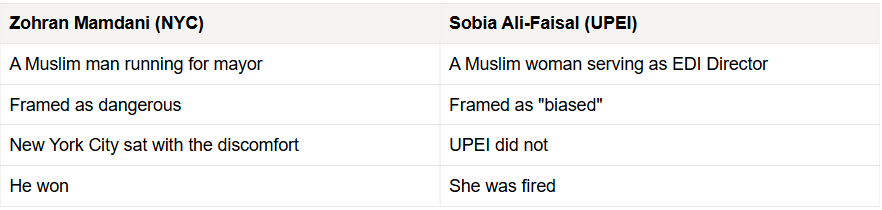
The difference was the institution's tolerance for fear.
New York City was willing to sit with the discomfort of a Muslim man in power. UPEI was not.
This is what happens when colonial thinking meets Muslim leadership. The institution protects itself—not the person, not the community.
As we said in that presentation:
"My story is not unique. It is a symptom of a structure."
VI. Colonial Patterns and the Denial of Belonging
In that same presentation, we mapped the colonial patterns that make stories like mine inevitable:
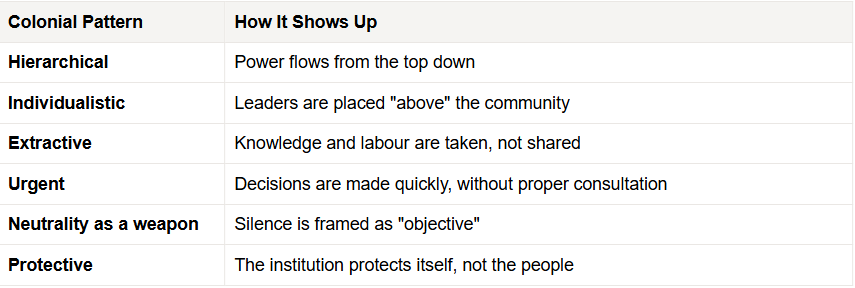
The result?
"Marginalized people are hired, consulted, and removed when their expertise becomes inconvenient."
We contrasted this with Indigenous governance structures, which are relational, consensus-based, and accountable to community and land rather than to institutional self-preservation.
But the point I want to underscore here is this:
Colonial institutions cannot tolerate the truth because the truth threatens their existence.
When I named genocide, the institution couldn't argue with my substance. So it removed me. When Dr. Khilanani named civilization-level lies, the institution couldn't engage with her analysis. So it reduced her to a soundbite. When Ms. Rachel named the humanity of Black and Brown children, the institution couldn't deny their humanity. So it called her "extremist."
This is the pattern. This is what selective innocence protects. And this is what happens when you refuse to participate in it.
VII. The Non-Negotiable Foundation of Equity Work
Here's what I need to say plainly:
All of the EDI work - all of the anti-oppression work, equity, inclusion, belonging - absolutely cannot be done unless we engage in radical honesty.
Not optional. Not something we can do "eventually." Not something we can tiptoe around to keep everyone comfortable.
If we really want to do equity work, if we genuinely care about inclusion, if we genuinely care about justice, if we genuinely want to dismantle oppression - then radical honesty is the foundation. There is no exception.
You cannot dismantle a system you refuse to name honestly.
You cannot address oppression while pretending the oppression doesn't exist.
You cannot create belonging while engaging in selective innocence, while choosing to ignore the uncomfortable facts, the systemic realities, the personal complicity that makes belonging impossible for marginalized people in the first place.
You cannot build a new world while refusing to see the harm of the old one.
Fatima Khadijah's post named this:
"Whiteness is a system of rewards for staying silent about the suffering of others."
If you benefit from that system - if you stay silent to protect your proximity to whiteness, to power, to comfort - you are not doing equity work. You are performing it.
And performative allyship is not allyship. It is complicity dressed up as virtue.
VIII. What Radical Honesty Actually Requires
In our podcast, Auntea-ology: The Antidote Dialogues, my co-host Mueni and I talked about what it means to stop performing peace and start speaking truth. You can check out our conversation on radical honesty here: https://tinyurl.com/5t7mc7hs
Radical honesty isn't about being authentic in some feel-good way. It's about recognizing that silence protects systems, not people. The alternative to honesty isn't safety. It's complicity.
Here's what I've learned: the systems of oppression we are working to dismantle are built upon lies, layers and layers of lies. Lies about Black, Brown, and Indigenous people. Lies about disabled and queer people. Lies about immigrants. Lies about poor people. Lies about women. Lies about "the other."
And silence protects these systems. Not people.
My story is a reminder that some of us are already read as "dangerous" before we open our mouths. A Muslim woman speaking about Palestine? Already a threat. A Brown woman naming casteism? Already biased. A person of color calling out white supremacy? Already an enemy.
But the alternative is silence. And silence isn't neutral, it's a vote for the status quo.
Dr. Khilanani put it this way: if you benefit from a system built on a lie, and you never say the lie out loud, are you actually an honest person? Or are you just a well-adjusted participant in a very old delusion?
Fatima Khadijah echoed this:
"In order to dismantle white supremacy, we have to be comfortable losing the benefits of whiteness. We have to be comfortable being uncomfortable."
That's what radical honesty asks of us. It asks us to sacrifice our proximity to power. It asks us to trade selective innocence for hard truths.
Because otherwise, as the post said:
"Black and Brown children will continue, yet again, to be abducted, abused, and murdered, and nothing will change."
That's the hard truth.
IX. Truth Comes Before Reconciliation
Recently, an international, independent body found Canada guilty of genocide of Indigenous peoples.
I saw many people denying this. Calling it hyperbolic. But Canada has committed a genocide of Indigenous people. And we can easily argue that it is still ongoing.
That is the truth.
But if we can't even acknowledge it, how will we speak it? And if we don't speak it, how can there be reparations and reconciliation?
There's a reason "truth" comes before "reconciliation."
You cannot solve a problem you refuse to name honestly.
In our presentation, we asked a question that I want to leave with you:
"When a marginalized leader or colleague speaks truth - when they name the oppression their community faces - does your institution have the capacity to hold that truth, or does it have to remove them?"
X. Messy Questions to Sit With
Here are some questions to sit with, from our podcast, from Fatima Khadijah's post, from our presentation, from this conversation:
If you accept civilization-level lies and engage in selective innocence, are you actually an honest person?
What's the one thing you're not saying out loud, and who would it cost if you did?
When did you last lie to keep the peace? And what did that lie cost you?
If honesty is the antidote, what's stopping you from taking it?
Are you willing to lose your proximity to whiteness, or to power, in order to stand with the marginalized?
Is your kindness willing to stop caring at the border?
What is ONE concrete, measurable action you can take in the next 30 days to shift power to a marginalized voice, instead of just consulting them?
XI. Come Quiet. Leave Louder.
Dr. Khilanani named the lie. Ms. Rachel refused to stay silent. Fatima Khadijah named the mechanism. I paid the price for speaking truth.
The question for all of us is: will you?
Because radical honesty will cost you. But the alternative is complicity. And we have seen way too much of that.
The more people who are honest, the harder it becomes to silence us all.
The truth isn't the danger. The silence is.
What they're afraid of isn't your voice. It's what happens when we all start using it.
And the times we're in right now call for us all to speak the truth.
As we closed our presentation:
"Genuine belonging is not about making everyone comfortable. It is about making sure that the people who have been silenced are finally heard. Even when that hearing makes the powerful uncomfortable."
"Belonging is not a gift the powerful give. It is a right the powerful have stolen, and must return."
"Silence protects systems, not people."
So I'll leave you with this:
Come quiet. Leave louder.
Stay messy. Stay curious. Stay loving.